Tuesday, July 14, 2015

International Rice Institute

IRRI Introduction Video

We visited the International Rice Research Institute, and we had the amazing experience of talking to one of the scientists who is working on climate change rice. It is astounding how the rest of the world has accepted the reality that our climate is changing, but it is still a debatable topic in the U.S. The Philippines is at the epicenter of climate effects. They are experiencing the devastating effects of multiple typhoons each year.

Rice seed storage


Embassy and Three Schools


Although we could not take our own pictures and had to leave our cell phones in the van, we did meet with Philip S. Goldberg, US. ambassador to the Philippines. He discussed the history of the Philippines and American education such as the Thomasites. I am paraphrasing, but he said, "America was not very good at colonizing because we focused on education. The Spanish and the English kept their colonies marginalized and powerless because of this lack of education. There is a great love for America in the culture, but we all know that American influence and power comes at a price for developing nations. 
Printed posters with names and pictures are very big in the Philippines. We were welcomed at every school with a personalized banner. I wondered about how much all the printing might cost, but it did not seem to be an issue.

This picture is of me in the culinary classroom of St. Paul College for girls in Manila. They have almost 4,000 students in this school. They suffered from the same problem of keeping teachers that all the private schools seem to suffer from. The public schools pay at least 25% more than private schools, so teachers are always leaving for more money.
The Philippines has small businesses everywhere. It doesn't appear that they must go through too much regulation to open restaurants, meat markets, vegetables etc. A "canteen" is mostly a place that sells food from large metal pots. I was super curious about these places, but we never ate at any of them because we were heavily warned that this would be gastronomically problematic.
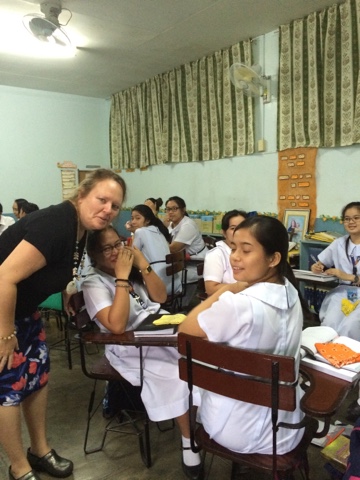
This classroom is typical of a private school. In both public and private, students stay in one class and the teachers move from class to class. This teacher is discussing the Writing Process


Benigno "Ninoy" S. Aquino High School 
We also toured a public high school in Makati. Classes were a bit larger, but this was also a high school that many students "chose" to come to instead of their neighborhood schools.

Friday, July 10, 2015

Teaching!


I got to teach today!!! The kids were really nervous speaking to me. We feel like rock stars here because they get so excited ad nervous to speak to us. I wish my own students were as excited for me to teach them.

After talking with my host English teacher, Charlotte, we decided I could lead teach the Pardoner's Tale by Chaucer. Philippines English curriculum contains many Western Works of Literature, so I was able to jump right in with a lesson. I followed the format of the other classes I had observed. Start with a focus activity; give some direct instruction, and have them answer questions in groups. Then each group should share and discuss with the class.

r

The students were so excited that sometimes I had to reign them in to make sure that they were learning from me. I wonder how long it would take for me to teach in the Philippines before they treated me as an ordinary teacher.  At this point, I think they view the culture of the US and anything American as something that they are very familiar with because of television, but also something difficult to grasp in the ordinary and everyday.

Wednesday, July 1, 2015

Learning and Life

I'm
Our adorable students, they carry little pieces of cloth to wipe the sweat from their faces, and they carry hand fans, both boys and girls do this. The fans are really helpful.


We visited Dualtech Training Center on Wednesday. Dual Tech is an innovative program that recruits boys from poverty situations and trains them in a technical vocation. After training, they continue to mentor the boys as they work at the company. The program is funded in part by the corporations, so that they have trained workers. 


Koi Fish at the shops where we ate lunch. Someone is feeding them, so they are really going after the bait. 

Faith, Family, and Food


Our journey begins early in the morning as we are picked up by our sweet driver. He does not speak much English , but he weaves through the traffic in the streets with excellent accuracy.

It is Pope Day! The Pope is loved by the Filipino people.

Meeting about Filipino culture with the Filipino teacher and with student representatives. We discussed the gesture of respect mano po. The children touch our hands to their foreheads as respect. Mano or Pagmamano is a gesture used in Filipino culture performed as a sign of respect to elders and as a way of accepting a blessing from the elder. Similar to hand-kissing, the person giving the greeting bows towards the offered hand of the elder and presses his or her forehead on the elder's hand. Usually performed with the right hand, the person showing respect may ask “Mano po” to the elder in order to ask permission to initiate the gesture. Typically someone may mano to his or her older relatives upon entry into their home or upon seeing them. [1]
The word “mano” is Spanish for “hand” while the word “po” is often used in Filipino culture and language at the end of each sentence as a sign of respect when addressing someone older. Put together, “mano po” literally translates to “your hand please” as the greeting initiates the gesture of touching the back of the hand of an elder lightly on one’s forehead. The Philippines is the only country in Asia that holds this specific tradition and its origins evolved from the mixture of western and eastern tradition.

They work in groups even more than we do, and the students are energetic and full of life!

Two families took us out for a tour of Calamba. We ended the day with "snack" the fourth meal around 4:30 every day. I have become accustomed to eating the extra meal.